Thursday, 31 May 2012

Malaysia's Real Estate Market - Prices gone haywire?

Kuala Lumpur and its close neighbours are perhaps the main hotspot for real estate investment, often called the Klang Valley. Looking at these core regions, as described before, we find serious oversupply, e.g. in luxury condominiums, office space as well as retail space. This oversupply situation usually means massive discounts and for office space, you would be right to expect so. 
Average prime office gross rents/month
Following DTZ Research, we are at the beginning of a slow downturn of prime office space prices. The diagram offers an idea of what is supposed to come. From a quite obvious peak in 2008, slowly rental prices are going down over the last yeasrs and might even accelerate the plunge during 2012. This effect might be increased as we cannot predict the total impact of the crisis in Europe and the slowdown in China. On top and as always, we have the unique situation of a massive amount of projects to be completed and therefore a big income of new office space supply in 2012. DTZ offers an overview in the second diagram, which shows that 2012 seems to be a developing or better completion peak for office projects in comparison with previous years as well as compared to plans for the coming years. Anticipating this development, we can expect during 2012 and 2013 a lot of pressure on office rentals. In this context, we even can conclude that for this specific sector a price bubble is rather unlikely.
Office development pipeline
What is next? Well, I will not extend a lot of attention to retail and industrial real-estate, since they usually do not become driving forces of a bubble. For industrial, we can already conclude that the overhang is rather small, while retail suffers especially in the range of cheaper shop lots of RM 250,000- RM 500,000. Larger projects, especially large retail malls, demonstrate strength in the current market. Furthermore, Malaysian consumers are still hungry for exciting new mall experiences, which increased the demand for integrated mall and entertainment projects. Mostly, vacancy has been low and replacement was achieved quickly. Consequently, this segment in the market seems to be less likely creating a bubble.(NAPIC Dec. 2011: Property Market Status Report Q4 2011) Moreover, if we look at the subprime crisis of the US, the main issue was the believe of private investors in residential property prices. Since they were supposed to always go up, loans would not cause trouble. Unfortunately prices went down and most investors could not settle their loans by simply selling their house. Certainly, there are other factors involved, but that does not concern this post. In the context of Malaysia's real estate market today, luxury condominium and overal luxury residential projects (incl. housing), although oversupplied, keep on testing new hikes every day. (DTZ Research 2011: Property Times) Property valuers  are puzzled and discovered that recently the primary market is considerably higher priced than the secondary market. That alone in prime areas would not be impossible, but we are talking about development in the periphery. Here normally people would buy houses below RM 500,000 (below USD 150,000). The sq ft would fetch perhaps RM 400 - RM 500, and  below. Developers are trying their luck and there are already adverse signals from the market. With prices going up to RM 3 mio for houses and more or respectively RM 600 - RM 700 per sq ft, the take-up of new units in mentioned projects is slowing down.
Lux. development in Kepong
From my personal perspective, it is a troublesome development to see prices going up that much in townships such as Kepong, Cheras or Ara Damansara, as these spots are partly more than 20 km away from KL-city. People specifically buy in these areas to escape overprized condos and houses in Bangsar or Damansara Heights, while not only the distance is an issue. The overal development, convenience, entertainment, education, you name it, cannot challenge the older hotspots yet. Some developers obviously argue, they invest a lot in security, but valuers clearly mention that this could only offer a premium up to 30 %. Besides, let us not talk about the neighbourhood. (Thean Lee Cheng 5 May 2012: Where is the market heading?)    
 
What reasons could we find for this unusual development, which puzzles valuers and customers alike? Well, greater Kuala Lumpur is expected to grow to 10 mio citizens by 2020. The drive into urbanisation and away from rural areas is strong. The potential for rising residential and commercial real estate seems to be set. Furthermore, foreign investors, who currently just comprise about 2 % of unit sales, are supposed to be attracted. In this context, Malaysia Property Inc. has been setup, as the sole government agency to promote Malaysian real estate to foreign investors. For more on MalaysiaProperty Inc, just follow the link.(Thean Lee Cheng 3 March 2012: Malaysia a real-estate shopping destination). It is also known that Malaysian's have a strong investment interest in real estate and heated up the market themselves. Observers stated that besides the developers price testing efforts, there are a lot of Malaysians who speculate on rising prices with their private money. The newspapers pointed at stories, where people would loan money for three or more luxury condos during the early sales period. This investment is way above their income and the banks are also to blame on it. While the project is completed and prices tend to rise, they would sell it off. This matter has caused quite some worries in the market and Bang Negara addressed this risk by announcing new guidelines for banks' lending policies. (The Star 24 April 2012: Bank Negara defends rules) This could already cool down the property market, which is why I will pick this matter up in my next post.

Another concern or let us call it some heat for this discussion has been added by local house buyers recently. It was for the ongoing price hikes that consumer advocates pushed forward and tried to increase the price tags for foreign investors to at least RM 1 mio. They claim that foreigners are responsible for the price hikes and Malaysian citizens, especially the middle income groups, were not able to afford housing or find condominiums in prime areas. On this one, I could be cynical, but let us be rational.

Real Estate Sector Price Spread
Firstly, I wonder, if these guys have done any research. Only 2 % of the yearly sales in real estate goes to foreigners. Secondly, foreigners already have to buy units above RM 500,000 according to the law. Now let us look the price spread of units in the market and what it tells us. The diagram on the left is in particular quite helpful and based on research of Malaysia Property Inc. If we take four real estate hotspots, we will realise that actually only Kuala Lumpur has a significant price hike of more than 40 % luxury residentials on offer. I believe for most experts and anybody with a rational perspective, this would make sense. Kuala Lumpur as capital and with only a limited amount of land available for development, but rising demand would see the demand driving prices up. Similar issues are seen in major cities globally such as Tokyo, Shanghai, Hong Kong, Singapore or London, Paris and Rome. I doubt that Americans start to complain about the sq ft price in Manhattan, New York, where we can see an average of more than USD 1,000. Not talking about prime property at all. Take a look at the article of CNN (CNN Money 2012: NYC apartment sells for a record USD 88 million). Probably Americans understood the principles governing prices, supply and demand. I really tried not to be cynical. Anyways, since we can conclude that hikes are mainly based on an exceeding demand for property in central locations, such as Kuala Lumpur, the point for a new price tag having a great effect on overall real-estate prices in Malaysia is quite weakened. Just take a look at spots such as Penang, which is basically an island with very limited space. Furthermore, in Johor we will find some places, where Singaporeans are taking up a lot of units and prices go up. I mentioned Iskandar before. After all, many large-scale development projects, such as Iskandar, are not possible without foreign investors. In the end, we are talking about very small areas. Malaysia Property Inc's KUMAR THARMALINGAM puts it like this: "The rest of the country is pretty much stuck in the RM300,000 RM600,000 category."  For more on this matter, I can also recommend his comment in The Star: The Star 5 May 2012: Priming, pricing KL property for the future. 

In an election year, it is expected that people start screaming about "indisputable injustice" in Malaysia, e.g. that they cannot buy a house above their living standard.The most noise came from middle income groups, which would like to buy houses below RM 1,000,000, but in prime areas. There is indeed a shortage, since we have an oversupply in luxury and cheap residential property. However, I cannot see a solution, since in Kuala Lumpur prices will go up along the high demand and little supply. If you want to stay in the city, you need deep pockets.

Knowing more about the pricing and developments in the market as well as some irrational fears and populism, I will finally conclude on the question of a bubble in Malaysia. Prices partly went haywire, but I believe the market will correct these matters. Since sales did not take off, developers will need to adjust. After presenting so many facts and developments, I am sure everybody agrees that it is not as simple as it seemed in the very beginning. Let us put the puzzle together.

Stay tuned for my next post and the final question on whether or not we are heading towards a real estate bubble.

Tuesday, 29 May 2012

Malaysia's Property Market - Review

The Malaysian real estate market has been driven by local demand ever since, as only 2 % of all sold real estate units go to foreigners at all. Compare this with about 30 % in Singapore, where regulation only allows investment in private condominiums and a 10 % stamp duty comes on top. (The Star 3 March 2012: Malaysia real - estate shopping destination) Domestic demand is usually seen as a good sign, since it decreases dependencies on international money, especially when investors suddenly try to pull-out. In this context, it might not surprise that the last quarter of 2011 saw a jump of 3.6 times in real estate investment transactions, but certainly the listing of a major REIT contributed most of it, some RM 3.54 bil or USD 1.12 bil. 
Property Stock in selected States of Malaysia 2007-2011
While in Kuala Lumpur the incoming supply of new units is just about 38,000 for last year, with existing stocks of about 410,000 units, you can see in the tabble above that states such as Selangor have 136,000 units coming in on a stock of more than 1 mio. units. (Malaysia Property Inc Jan 2012: property quotient) This small comparison shows already the main problem. 

Selangor and Greater Kuala Lumpur
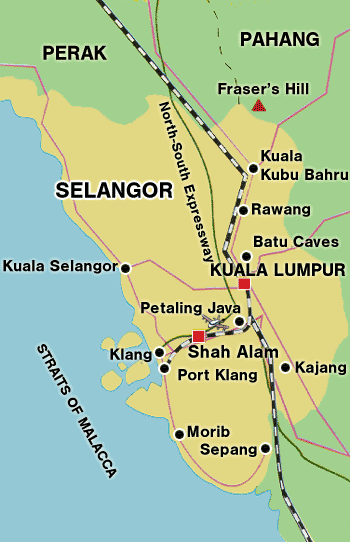
Kuala Lumpur with a limited space of 243 sq km, but 1,6 mio. citizens has little land to develop. However, the demand is rising to live in this buzzing city with its jobs and high living standard. Obviously, we can understand certain price hikes out of this situation. Nevertheless, Selangor is profiting, too. As the direct neighbour of Kuala Lumpur, Selangor has already more than 5 mio citizens. Morever, there is also a vast area of 8,100 sq km to be developed. Cities such as Petaling Jaya, which are in close proximity to Kuala Lumpur have seen a steady rise of real estate prices. For the convenience of staying close to the capital, but paying less, more and more people were pouring into Selangor. This also explains the rise in incoming supplies for Selangor, where many new residential and commercial projects are in the pipeline. Similar developments can be found in regions such as Penang or Johor. While Penang State has a densely populated island with enormous real estate prices, it also offers cheaper commercial and residential land on the mainland. Finally Johor as a real estate hotspot profits from its neighbourhood again. 
Iskandar in Johor and close to Singapore
With a direct connection to Singapore, the relatively cheap real estate in Malaysia attracts the attention of Singaporeans. They become cross-border commuters, but leave quite some Sing Dollars on Malaysian soil.We shall not complain about this situation, since massive development projects all over the country, such as Iskandar, are profiting from rich neighbourhood and foreign investments. Moreover, the Malaysian government tries to attract more foreigners to boost growth within these projects. Nevertheless, we were talking about a bubble and I started wondering, if the rich neighbourhood might calm down the effect of oversupply and therefore prices still go up.
MY Property Overhang 2011 (compl.)
If you look at the statistic in the diagram, we have quite some overhang in many different sectors. Certainly, the residential sector is by far the worst issue. There we can find an incredible overhang valued some RM 4.9 bill. by the end of 2011. Interestingly, one of the main points in the statistics worth mentioning would be the fact that the amount of units went down, while the value of the overhang went up. I have to admit that this development could have many explanations, including units being revalued, but it could also be a part of the swing to luxury projects. In addition, we would need to look at the units under construction and planned, as above only completed projects are represented. While sales is slightly going up, we still need to acknowledge that counting in the completed, constructed and planned projects some 100,000 units are not sold yet, worth several billion MYR. (NAPIC Dec. 2011: Property Market Status Report Q4 2011) What shall we make out of this?

On the one hand, I outlined before that we have seen price hikes, which seems to be surprising in regard to the high-value oversupply. On the other hand, sales is improving and foreigners slowly stream into Malaysia, who are willing to pay premium prices. So are the rich kids spoiling property prices? Let us take a look at this matter. In that context, I will also provide information on the general market prices and what is currently happening....stay tuned for my next post.

Sunday, 27 May 2012

Malaysia's Real Estate Market – Bubble or Opportunity?

View on Petronas Twin Towers in Kuala Lumpur
The real estate market is a hot issue in Malaysia and that is not only because of CNBC, which rated Malaysia 9 of the top 10 hottest real estate markets globally. This rating was based on research by Knight Frank, an international real estate consultancy. (for more details: CNBC 2012: The World’s hottest Real Estate Markets) While everybody remembers the headache of the US subprime crisis, in Malaysia people feel determined to venture into property right now. Just a few days back, I met with the brother of a famous fashion designer here in Malaysia. It was obviously about getting some new suits, but we ended up talking about real estate. I told him that I will stay in Malaysia and intend to buy property myself. He promptly said: "Buy now." I asked him, in a quite naïve way, if we are not heading straight into a real estate bubble. Prices have been rising and almost everybody tried to make a profit out of it recently. He responded in a pretty simplistic way: “There could be a slight downfall or setback, but the prices will keep on rising.” From my observation, this is a general attitude of Malaysians and many people hope to make a fortune in real estate. In other words, property is a booming business with prices rising by about 28 %.(CNBC 2012: The World’s hottest Real Estate Markets)

Now that looks like a bubble, doesn't it?
Many educated people would say, the undisputed belief in ever rising prices is not going along well with fundamental economic theories as well as real-world events such as the global downturn caused by Europe and slowing growth in China. However, there is a lot more happening in Malaysia, than what I told you so far. In order to give you an idea and also some thoughts on the investment environment, I would like to throw some figures at you and see what happens in the market. In addition, I talk a bit about regulation changes and round it up with recent discussions on foreign investment in real estate, price caps and similar desires.

With REITs becoming more important and less restrictions on property investments for foreigners, Malaysia offers more opportunities than the highly regulated market of Singapore. Stay tuned for more insights into the development and prospects of Malaysia's property market.

Wednesday, 16 May 2012

Chinese Ghost Story III - Financial Scenarios in China

Finally, I wish to come to the tricky part of this story in regard to the unshaken belief in China. Bo Xilai pushed Chongqing’s economy hard for his political campaign to enter the circle of leadership of the communist party in Beijing. His investment policies were based on support programs for the inland provinces in opposition to the rather developed coastal provinces.  Due to the success of this project, he also made use of quite questionable investment vehicles to keep Chongqing going. The steady inflow of money and investment projects produced quite a hike in the real estate of that region, which Bo utilised for his investment policy. He backed his loans through the governmental real estate assets, while he firmly believed in its rising value. This strategy is alright, if investments are driving your real estate prices up, but it can be devastating when the investments slow down or come to a complete stop. Looking at the most recent news, China's foreign direct investment as well as other economic indicators are falling for the last six months.(The Wall Street Journal 15 May 2012: China Foreign Investment Falls Again) Obviously, we have to consider the situation in Europe and the US, which is threatening enough, but what if China goes down?

The Chongqing Scenario

Chongqing skyline
Currently, Chongqing is said to be burdened with about USD 30 billion. At this point, it is getting interesting to me, as people love to look at China as the stable and growing giant. What happens if China's growth is slowing down? We see more cities in trouble, since FDI will fall, factories are closed and all of this is quite likely in the current economic situation. Only Chongqing suffers from USD 30 billion, but what about the the rest of China. All provinces are very competitive and their leaders need to achieve certain goals to further their careers. On top, the local governments have a lot of freedom in regard to their fiscal and budgetary policies. Bo Xilais story is an extreme, I agree. Still, the debt risk is rising. Just assume an overal debt of USD 1 billion per 1 million citizens in a city. There are about 160 cities with more than 1 million citizens. I am sure you can do the maths, but keep in mind that there are many cities with more than 1 million and another 500 cities with 100,000 and above. Besides, we are only talking about the communal level. Certainly, there is no proof for this assumption, which is why I call it a scenario. The PR China does not really let us look into their books, but there is more to this issue. A last comment below.

China’s banking system is just another time-bomb of nonperforming loans (NPL). Many experts assume that China’s banks intended to list themselves on international stock exchanges to collect fresh money and cover the domestic NPLs. Basically, that is what they did during the last few years. Some weeks back, Reuters updated on this issue and mentioned that several banks are struggling with rising NPLs, again. And again, the main beneficiaries were local governments and the real estate sector. Does that ring a bell? (Reuters 29 March 2012: Update 2 Nonperforming loans tick higher at Chinese banks)

Stay tuned for my next story, coming back to Malaysia and ASEAN. Be smart and diversify.

Chinese Ghost Story II - Bo Xilai rises and falls

As mentioned before, I wish to talk a little aboeut Bo Xilai, but since globally other issues become more important, I keep it short. He was a man dreaming of being a big boy in Beijing and achieved already several high provincial positions, such as Governor of Liaoning. He would become Minister of Commerce for one term and finally arrive in Chongqing. His strategy in opposing the current leadership was based on populism, which comprised topics such anti-corruption campaigns and Mao –era communism. Afterall, it is not unusual that a rising star of the provinces wants to settle in Beijing. Afterall, the central government does put a lot of pressure on their governors by setting specific growth and development targets. Often economic support programs and grants are connected to these goals. Obviously, the stakes are high, old elites feel threatened and China is simply no democracy with freedom of speech or press. In the end, Bo Xilai's story sounds like he fell for the greed, which he condemned so much. Sure, there are a lot of politics and we can follow the targetting of his family. However, it is not likely that he is an innocent victim. Obviously, his family was involved in investment projects, which indicate corruption and fraud. For more on the politics, I recommend this article, The Heritage Foundation2012: Bo Xilai’s Fall Is Not Going to Lead to Reform in China.


from left: Gu Kailai, Bo Xilai, Neil Heywood, Wang Lijun
Here are some details on the the saucy parts of this story. Bo Xilai has been in the news for corruption and fraud as well as murder. Officially his wife, Gu Kalai is investigated in regard to the murder of long-time business associate and friend Neil Heywood. Heywood originally from Great Britain was said to support the business efforts of Gu Kailai. Obviously the murder developed out of an argument on money laundering. Gu Kalai asked Heywood to bring money out of China, while Heywood was unhappy with his share of the deal. Well, better do not mess with the dragon. The lady got him killed most likely. Not really surprising though, there was one article that she posed in a uniform of a PRC army general. I suppose she is still looking for her Chi, while others say it was about the Bo's city chief of police, Wang Lijun. Wang has been partly revealing details on the murder and accused Gu Kailai of covering up the case. It should be mentioned that Wang had been demoted by Bo Xilai over another scandal. Since the current leadership of the PRC did have some issues with Bo and started to target his family, I also want to mention the possibility of a plot. Especially, due to the fact that Wang came out with his story at a US consulate and holds a grudge against Bo. However, it is not unlikely that Gu Kailai was involved. Recent media articles claim that the lady had a multi-million EUR  real estate investment operation in Europe, mainly France. This operation is led by a Frenchman, whose part in this story still has to be disclosed. More details have been brought to the attention of readers all over the world through Asian and Western media. Please also check on the links provided. ( The Telegraph 1 May 2012: Gu Kailai dressed up in army uniform and The News 16 May 2012: Frenchman maybe key to Chin scandal)

So far so good, what is next? Stay tuned for the economics behind.

Friday, 11 May 2012

A Chinese Ghost Story I – Bo Xilai in murder, money and party politics

Malaysia' Key Trade Partners 2010/2011
The story of Chongqing’s Bo Xilai and his wife, who most likely murdered a British businessman and friend, has been in the news for more than 2 weeks. Going through local newspapers, I was able to read almost every day something new. Certainly, some people might wonder, why I am writing about China, as I dedicated my blog to Malaysia. There are quite a number of good reasons.

China has become one of the most important trade partners of Malaysia and is in permanent competition with Singapore for the largest trading partner. (Malaysia SME 2010: Malaysia’s trade with China records healthy growth) Even though figures are interesting, I believe there is another reason to talk about China. The country is in many ways overrated. No, I am not saying, don’t invest in China. How could I? Most people would call me crazy and I admit it might be crazy. China still grows at an incredible rate of 8,1 % in the first quarter of 2012. One popular argument also goes like this: “ if only 1 % of the Chinese population buys my product…”. Ok,  I am not asking anybody to ignore China and its potentials, but I would like to remind investors to be cautious about it.
I am suggesting diversification. Why is that? I could mention that just recently a journalist of al- Jazeera has been expelled by not renewing her press visa (BBC May 2012:China expels al-Jazeera English reporter). We could talk about the fact that this country is at best an autocracy, definitely some kind of socialist one party game, but at least something without democratic legitimisation. They crack down protests, impose censorship and have political prisoners. Well, recently Chinese media follows the stance that the Philippines are Chinese territory. (Irony Alert!!!) (Straits Times 10 May 2012: China TV claims Philippines as Chinese territory)
Bo Xilai
However, leaving all these issues aside, I want to talk about Bo Xilai and his story. He was a man dreaming of being a big boy in Beijing and achieved already several high provincial positions, such as Governor of Liaoning. He would become Minister of Commerce for one term and finally arrive in Chongqing. His strategy in opposing the current leadership was based on populism, which comprised topics such anti-corruption campaigns and Mao –era communism. After all, it is not unusual that a rising star of the provinces wants to settle in Beijing. Besides, the central government does put a lot of pressure on their governors by setting specific growth and development goals. Often economic support programs and grants are connected to these goals. Obviously, the stakes are high, old elites feel threatened and China is simply no democracy with freedom of speech or press. In the end, Bo Xilai's story sounds like he fell for the greed, which he condemned so much. Sure, there are a lot of politics, but it will be hard to proof a plot of communist party against Bo. Furthermore, his family was involved in investment projects, which indicate corruption and fraud. (For more on the politics, I recommend this article, The Heritage Foundation2012: Bo Xilai’s Fall Is Not Going to Lead to Reform in China)

Stay tuned for a short summary of the saucy story on Bo and his wife as well as some really alarming facts about Chongqing's financial situation or should I say, China's situation?

Tuesday, 8 May 2012

Minimum wage policy in MY - any downsides?

Investors

For investors, I cannot see serious downsides, because most of them have already introduced higher wages in Malaysia. Furthermore, many of these corporations are in high-tech manufacturing and not cheap-labour mass production. If there is any downside, then I would expect that there will be a gradual increase for minimum wages throughout the coming years. Consequently, Malaysia can become another expensive labour market in the future. With the policy in place and starting low, most investors have a lot of time to adapt. On top, we should not forget that foreign workers, besides other exceptions, are not covered by the new minimum wage policy.

Malaysian Industries

Glove industry margin trends
Rubber gloves have become one of the main export products of Malaysia and have been profiting from the low wages paid so far. The leading companies such as Top Glove or Hartalega pay their employees about RM 600 in peninsular Malaysia. As industry research indicates, labour costs account for about 7% - 9% of the total production costs. Having said this, we might not see a major consolidation in the market, but a small surge in prices to handle the higher production costs. Some companies consider to renegotiate certain allowances to deal with the costs, which could become a drawback for the employees. (The Edge 3 May 2012: Glovemakers face short-term margin squeeze by higher wages) 

Palm Oil
While the rubber industry and related products are  important sectors bound to suffer, we will experience similar issues all over the agricultural sectors. The second dominant product line would be palm oil. Malaysia has been the largest exporter of palm oil for many years, but lost this title to Indonesia in recent years. A price hike due to low wages in this industry is as likely as for the rubber and rubber glove industries. However, similar strategies are expected. Most companies will pass the higher labour costs to their customers. (The Borneo Post 26 April 2012: Mixed reactions to minimum wage implementation). An interesting question arises in regard to Indonesia. Will Malaysia lose more market shares to its neighbour or is the pricing effect rather marginal? Of course, it should be noted that often foreign workers are employed in these sectors, who are excluded from the minimum wage policy. 
My final remark on the whole issue of newly introduced minimum wages in Malaysia goes to the potential of modernisation and automation. Several analysts mentioned that labour intensive industries could feel enticed to modernise their operations, instead of relying on more expensive hands. From my current perspective on this market, I cannot see this shift happening. Firstly, as mentioned before, many of these industries are likely to employ foreigners, which do not benefit from the new policy. Secondly, Malaysian corporations are pampered by the government and would expect an extensive economic support program to sideline modernisation in affected industries. So far, I did not hear anything about such a program. It would certainly be another opportunity to collect voters for this election. Let us observe what will happen.

Leaving minimum wages aside, I am heading to murder, money and Chinese politics. Don't forget the involvement of French and English folks as well as scary financial liabilities. Certainly, some might ask, what is this to Malaysia? Wait and see. Are you ready for the thrill?